Night Football Returns to Anantnag After 3 Years as 50+ Teams Compete Under Floodlights
By: News Desk | 14 September 2026
There was a time when the floodlights at Anantnag’s Sports Stadium meant much more than an illuminated football pitch.
They meant crowds arriving after sunset, local teams playing in front of passionate supporters and young footballers getting an opportunity to perform when the day’s routine had ended.
Now that atmosphere is returning.
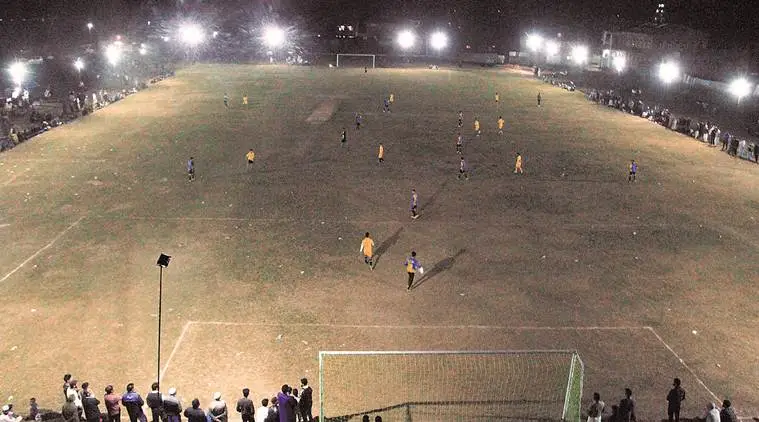
Night football has been revived at the historic Sports Stadium in Anantnag after a prolonged interruption, bringing evening matches back to one of South Kashmir’s important sporting venues. More than 50 teams are expected to be part of the competition, turning the event into one of the region’s significant grassroots football gatherings.
The development comes after a period in which sporting activity at the stadium faced interruptions and infrastructure-related challenges. Recent reports confirm that the venue has once again become active, with floodlights being used for football and large crowds returning to watch matches.
For Anantnag, this is not simply another football tournament.
It is the return of a sporting routine that has a particular place in the district’s social life.
Anantnag’s football ground lights up again
The revival follows the reopening of the Anantnag Sports Stadium earlier this year.
In June, the stadium hosted the second season of the Titan Football Cup, with Deputy Commissioner Anantnag Dr Bilal Mohi-Ud-Din Bhat inaugurating the tournament. The occasion also saw the floodlights switched on, allowing night matches to return to the venue. News18 J&K reported that football supporters turned up in large numbers for the event.
The return of night football is significant because the stadium has long been one of Anantnag’s principal public sporting spaces.
The venue has hosted football and cricket, while its floodlighting infrastructure has previously been used for evening sporting events. Government tender records also show that the Sports Council had earlier undertaken maintenance and operational work for floodlights at Sports Stadium Seer Hamdan, Anantnag, underlining that floodlit sport has been part of the district’s sporting infrastructure for years.
What has changed is the regularity and visibility of such events.
More than 50 teams turn the tournament into a grassroots showcase
The scale of the current football activity is perhaps the most encouraging part.
With more than 50 teams involved, the competition provides opportunities for players beyond the handful of established clubs and academies that normally attract attention.
That matters in grassroots football.
A talented teenager from a smaller locality does not necessarily have access to professional scouts or elite academies. Local tournaments can therefore function as an informal scouting network, allowing players to compete, make mistakes, develop confidence and attract the attention of coaches.
The Anantnag football ecosystem has repeatedly demonstrated that there is an audience for this.
A 2020 Anantnag Champions Knockout tournament, for example, drew large numbers of spectators to the Sports Stadium, with local supporters closely following matches involving district clubs.
The revival of floodlit matches adds another dimension.
Football is no longer confined to daytime fixtures. Families, students, workers and other spectators can attend evening games, potentially creating a much larger match-day atmosphere.
Why night football matters in Kashmir
Night football has a distinctive history in the Valley.
In 2018, Srinagar witnessed what India Today described as Kashmir’s first-ever night football tournament for budding athletes, with matches played under large-scale floodlighting. Organisers reported an audience of around 3,000 on the opening day.
The same tournament demonstrated something important about football’s popularity in Kashmir.
People were willing to come out in large numbers simply to watch young players compete.
Another report from the period described how floodlit football was helping create a different atmosphere in the Valley, with spectators gathering around the pitch after sunset.
That history makes the Anantnag revival more than an infrastructure story.
It represents the restoration of a sporting culture.
The stadium itself still has work to do
The return of football should not obscure the challenges facing the venue.
Publicly available reviews of Sports Stadium Anantnag have highlighted concerns over ground conditions, drainage and maintenance, although such user reviews are anecdotal rather than official assessments. Some spectators have praised the stadium and its location, while others have complained about the playing surface and waterlogging.
There is also evidence that sports infrastructure across Anantnag is undergoing continuing investment.
In June, the district administration said funds were being allocated for sports-facility upgrades, including floodlights, pitch-maintenance equipment and spectator stands. The administration also said new indoor courts were being developed for sports including badminton and volleyball.
And in 2026, the government floated a tender for flood restoration and reconstruction works covering several sports facilities in Anantnag, indicating that infrastructure improvement remains an ongoing process rather than a completed task.
That distinction is important.
A stadium can reopen, but sustaining sporting activity requires regular maintenance.
Footballers need a reliable playing surface. Spectators need safe seating and basic facilities. Floodlights need maintenance. Drainage needs to work when weather conditions turn difficult.
The revival of night football will be meaningful if these improvements continue after the tournament ends.
From entertainment to youth development
Sports officials and administrators have increasingly framed football as more than entertainment.
That argument is particularly visible in recent Anantnag tournaments.
In August, Youth Services and Sports Minister Satish Sharma inaugurated the Late Legends Memorial Knockout Football Tournament at the Sports Stadium. The event was organised under the theme “Say No to Drugs, Yes to Sports”, with officials presenting sport as a means of engaging young people and promoting discipline and healthy lifestyles.
The message is straightforward: give young people competitive spaces and structured activities, and sport can become an important part of their social and personal development.
Football is particularly suited to this because it is relatively accessible.
A proper ball, an organised ground and a group of players can create a team. From there, coaching and competition can turn recreational interest into serious sporting ambition.
A stronger football culture could help South Kashmir’s talent pipeline
The most important long-term outcome may not be the tournament winner.
It could be the player who gets noticed during the tournament.
Jammu and Kashmir has produced footballers who have reached higher levels of the domestic game, while the region’s clubs and academies continue to provide a pathway for younger players.
But talent development requires repeated competition.
A youngster who plays only a few organised matches each year has limited opportunity to develop tactical awareness, match temperament and physical endurance.
A tournament involving dozens of teams changes that equation.
Players face different styles, different tactical approaches and different levels of physical competition. Coaches can compare performances over several matches rather than judging a youngster from a single trial.
That is how grassroots football becomes a development system.
The crowd is part of the story too
There is another reason the return of night football matters.
The stadium is not only a workplace for players. It is a social meeting point.
Floodlit football changes the rhythm of the town.
Instead of matches ending before evening, supporters can gather after work or school. Local businesses around the venue can benefit from increased footfall. Young people can spend their evenings watching or playing sport.
The result is a small but meaningful sporting economy around the match.
The same pattern has been visible in other Kashmir football events, where large crowds have followed local competitions. The 2020 Anantnag Champions Knockout tournament, for instance, attracted sizeable spectator interest.
The return of night matches could strengthen that culture further.
Football can also become part of Anantnag’s wider identity
Anantnag is better known nationally for its landscapes, history and tourism potential than for football.
Yet sport can become part of a destination’s identity.
A well-organised evening tournament, filled with local teams and spectators, gives visitors another way of experiencing the district. It also creates opportunities for local photographers, digital creators, small businesses and sports entrepreneurs.
That does not mean a single football tournament will transform tourism.
But repeated sporting events can contribute to a broader calendar of public activities, particularly when combined with cultural programmes and other competitions.
For that to happen, organisers will need consistency.
One successful tournament creates excitement.
A regular sporting calendar creates a sporting culture.
The bigger picture: Kashmir’s sporting revival is happening at several levels
The Anantnag development should also be viewed alongside a broader expansion of organised sporting activity in Jammu and Kashmir.
In June, Anantnag’s Unity Cup cricket tournament brought together 64 teams, while the district administration said it was allocating resources for sports infrastructure across the district. Officials specifically stressed that development would not be limited to cricket and would include football, volleyball and indoor sports.
That approach is important.
Cricket dominates India’s sporting conversation, but football has a different grassroots footprint. It requires relatively limited equipment, can be played by large numbers of youngsters and has strong community participation.
If Anantnag can maintain regular football tournaments alongside cricket, athletics, volleyball and indoor competitions, its sports ecosystem could become considerably broader.
The real challenge is what happens after the tournament
The floodlights are back.
The teams are playing.
The crowds are returning.
But the real measure of success will come months after the final whistle.
Will the most promising players receive advanced coaching?
Will local clubs get more opportunities to compete?
Will the stadium remain available for regular evening fixtures?
Will infrastructure be maintained?
Will young players from smaller parts of the district get the same opportunity as those from established football centres?
Those questions will determine whether this is simply a successful tournament or the beginning of something larger.
The government has already indicated that sports infrastructure is being expanded, while recent football events show that there is strong public demand.
The next step is to connect the two.
A floodlit pitch can mean more than a football match
There is a certain symbolism to the lights coming back on at Anantnag’s Sports Stadium.
For footballers, they mean another match.
For coaches, another scouting opportunity.
For families, another evening outing.
For young players, another chance to be noticed.
And for a region where sport has increasingly been promoted as a way of encouraging healthier and more constructive youth engagement, the significance goes beyond the scoreline.
Anantnag’s football tradition never really disappeared. It was interrupted.
Now, with more than 50 teams competing and night matches returning to the Sports Stadium, the Valley is getting another reminder of what happens when a football ground becomes a shared public space.
The test now is to keep those lights on, not just for one tournament, but for an entire generation of players.